John Frederick Willard

Home page

Appears as:

Born:

Parents:

Unit:

No.:

Rank:

Died:

Grave/Memorial: 
Willard, John F

1890, Portslade, Sussex

Felix and Isabella (née Mitchell)

2nd Battalion, Royal Irish Regiment

10160

Private

7 August 1917, Belgium, age 26

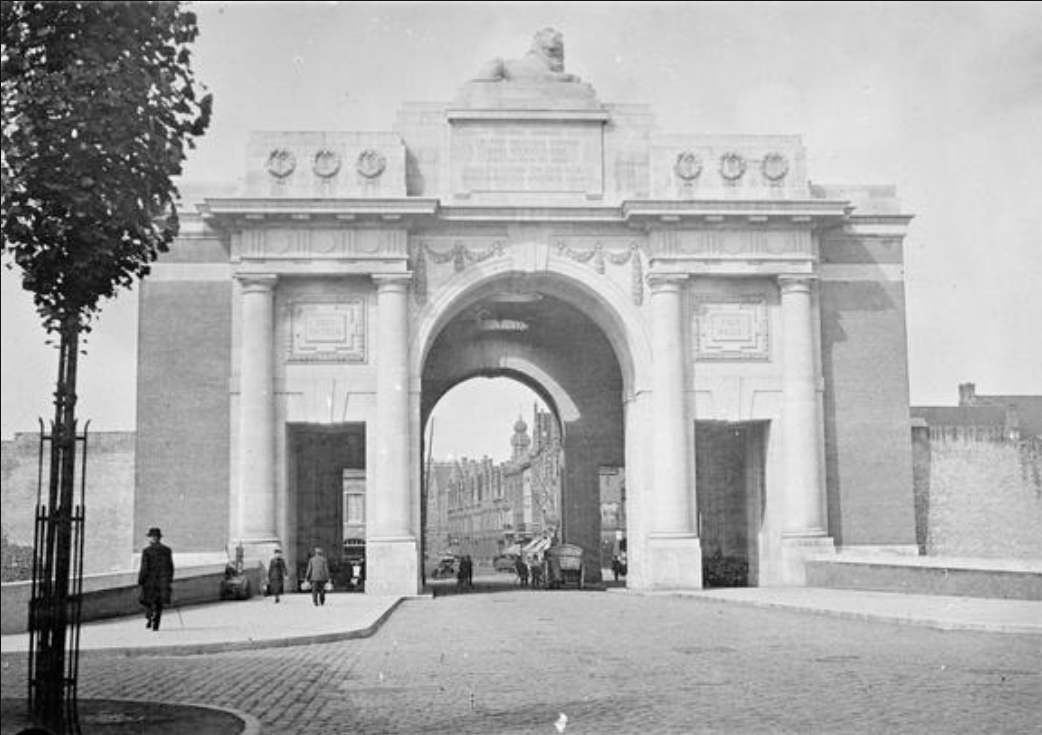
Menin Gate Memorial, Ypres, Arrondissement Ieper, West Flanders, Belgium: Panel 33

      

Biography:
John Frederick Willard was born in Portslade, Sussex in 1890. He was the son and fourth child of Felix, a general labourer, and Isabella (née Mitchell). He had three brothers and four sisters.

After leaving school, John worked as a cowman on a farm. In 1911 he was lodging at Addlestone, Surrey.

In August 1913, John married Elizabeth Annie Harwood, of St John’s, and they lived at Knaphill. They had a son and a daughter.

John enlisted with the Royal Irish Regiment, serving with the 2nd Battalion.

John Frederick Willard was killed on 7 August 1917. His final resting place is unknown. His name, along with others of his regiment, appears on panel 33
of the Menin Gate Memorial, Ypres, Belgium.


The Menin Gate is one of four memorials to the missing in Belgian Flanders which cover the area known as the Ypres Salient. Broadly speaking, the Salient stretched from Langemarck
in the north to the northern edge in Ploegsteert Wood in the south, but it varied in area and shape throughout the war.

The Salient was formed during the First Battle of Ypres in October and November 1914, when a small British Expeditionary Force succeeded in securing the town before the onset of
winter, pushing the German forces back to the Passchendaele Ridge. The Second Battle of Ypres began in April 1915 when the Germans released poison gas into the Allied lines north
of Ypres. This was the first time gas had been used by either side and the violence of the attack forced an Allied withdrawal and a shortening of the line of defence.

There was little more significant activity on this front until 1917, when in the Third Battle of Ypres an offensive was mounted by Commonwealth forces to divert German attention from a
weakened French front further south. The initial attempt in June to dislodge the Germans from the Messines Ridge was a complete success, but the main assault north-eastward, which
began at the end of July, quickly became a dogged struggle against determined opposition and the rapidly deteriorating weather. The campaign finally came to a close in November with
the capture of Passchendaele.

The battles of the Ypres Salient claimed many lives on both sides and it quickly became clear that the commemoration of members of the Commonwealth forces with no known grave
would have to be divided between several different sites.

The Ypres (Menin Gate) Memorial now bears the names of more than 54,000 officers and men whose graves are not known. The memorial, designed by Sir Reginald Blomfield with
sculpture by Sir William Reid-Dick, was unveiled by Lord Plumer on 24 July 1927.

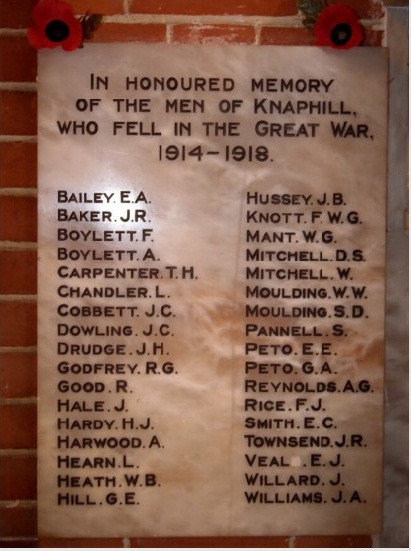
John Frederick Willard is also commemorated on the memorial tablet within Knaphill Holy Trinity Church (as J Willard).