Joseph George Stokes

Home page

Appears as:

Born:

Parents:

Unit:

No.:

Rank:

Died:

Grave/Memorial: 
Stokes, Joseph G

1894, Mortlake, Surrey

Joseph and Mary (née Over)

96th Company, Army Service Corps (attached to HQ 80th Infantry Brigade)

T.1384 / T4.038811

Driver

21 February 1917, Drowned at Sea, Greece, age 22

Body not recovered for burial.  Mikra Memorial.
      

Biography:
Joseph George Stokes was born in Mortlake, Surrey, in 1894 (although his previous two siblings were both born in St John’s).  He was the son and
youngest of four children of Joseph John, a baker, and Mary Ann. (née Over).  By 1911, Joseph’s family were living over the Capital & Counties Bank in
St John’s.  Joseph, then 16, was working as a plumber’s helper, for Mr J H Hayballs.

In April 1912, when he was 17, Joseph enlisted with the Territorial Force, joining the Surrey Brigade Company, Army Service Corps (ASC).  He stood 5
feet 5 inches tall.

When war broke out, Joseph volunteered for overseas service.  He was transferred from the Territorial Force, on 27 November 1914, to 96 Company
ASC. He was then 5 feet 10 inches and weighed 12 stone.

On 13 December Joseph was attached to HQ 80th Infantry Brigade, as a driver.  He disembarked at Rouen, France on 22 December. In January 1916, the HQ sailed from Marseilles and arrived at Salonica on 9 January.

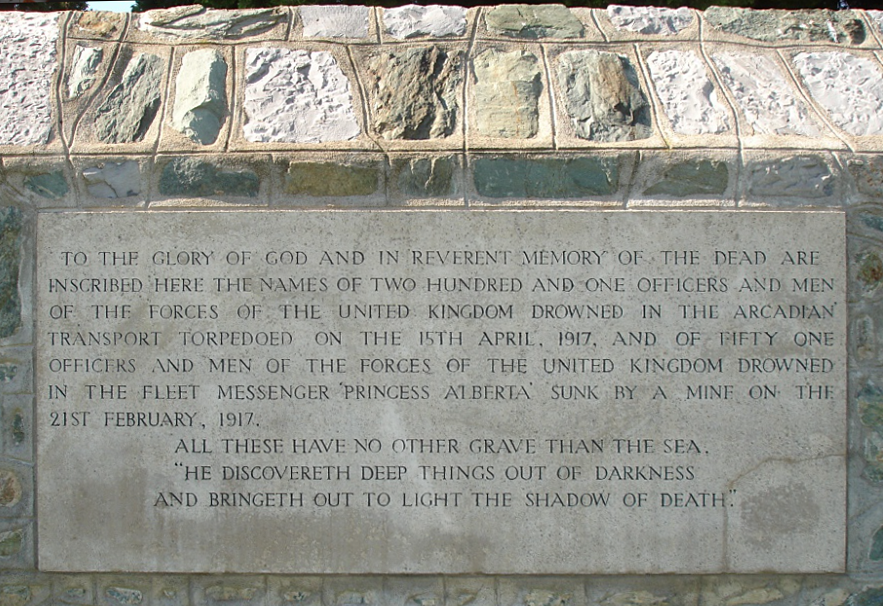
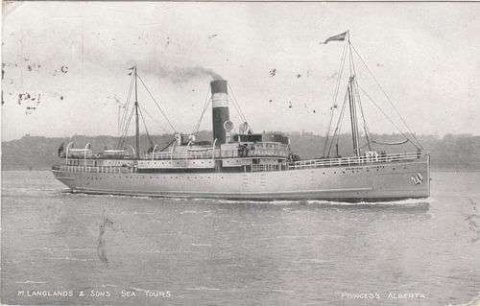
On 21 February 1917, SS Princess Alberta, on a voyage from Stavros (Thessaloniki, Greece) to Mudros (Lemnos, Greece), was sunk by a mine from the
German submarine UC-23, under the command of Johannes Kirchner.  The 1,586 tonne ship sank in Mudros Bay, part of the Aegean Sea.  33 people on
board lost their lives.


Joseph was on board the SS Princess Alberta and was officially accepted to have drowned on February 21 February 1917.  His body was never recovered
for burial. He is commemorated on the Mikra Memorial.


At the invitation of the Greek Prime Minister, M. Eleftherios Venizelos, Salonika (now
Thessaloniki) was occupied by three French Divisions and the 10th (Irish) Division from
Gallipoli in October 1915.  Other French and Commonwealth forces landed during the year. In
August 1916, a Greek revolution broke out at Salonika, with the result that the Greek national
army came into the war on the Allied side.

The town was the base of the British Salonika Force and it contained, from time to time,
eighteen general and stationary hospitals. Three of these hospitals were Canadian, although there
were no other Canadian units in the force.

The British cemetery at Mikra was opened in April 1917, remaining in use until 1920.  The
cemetery was greatly enlarged after the Armistice when graves were brought in from a number
of burial grounds in the area.

Within the cemetery will be found the Mikra Memorial, commemorating almost 500 nurses,
officers and men of the Commonwealth forces who died when troop transports and hospital
ships were lost in the Mediterranean, and who have no grave but the sea.  They are
commemorated here because others who went down in the same vessels were washed ashore
and identified, and are now buried at Thessaloniki.