Robert John Rands

Home page

Appears as:

Born:

Parents:

Unit:

No.:

Rank:

Died:

Grave/Memorial: 
Rands, Robert J

1880, Knightsbridge, London

John and Jessie (née )

“T” Battery, Royal Horse Artillery

28137

Sergeant

16 May 1915, age 35

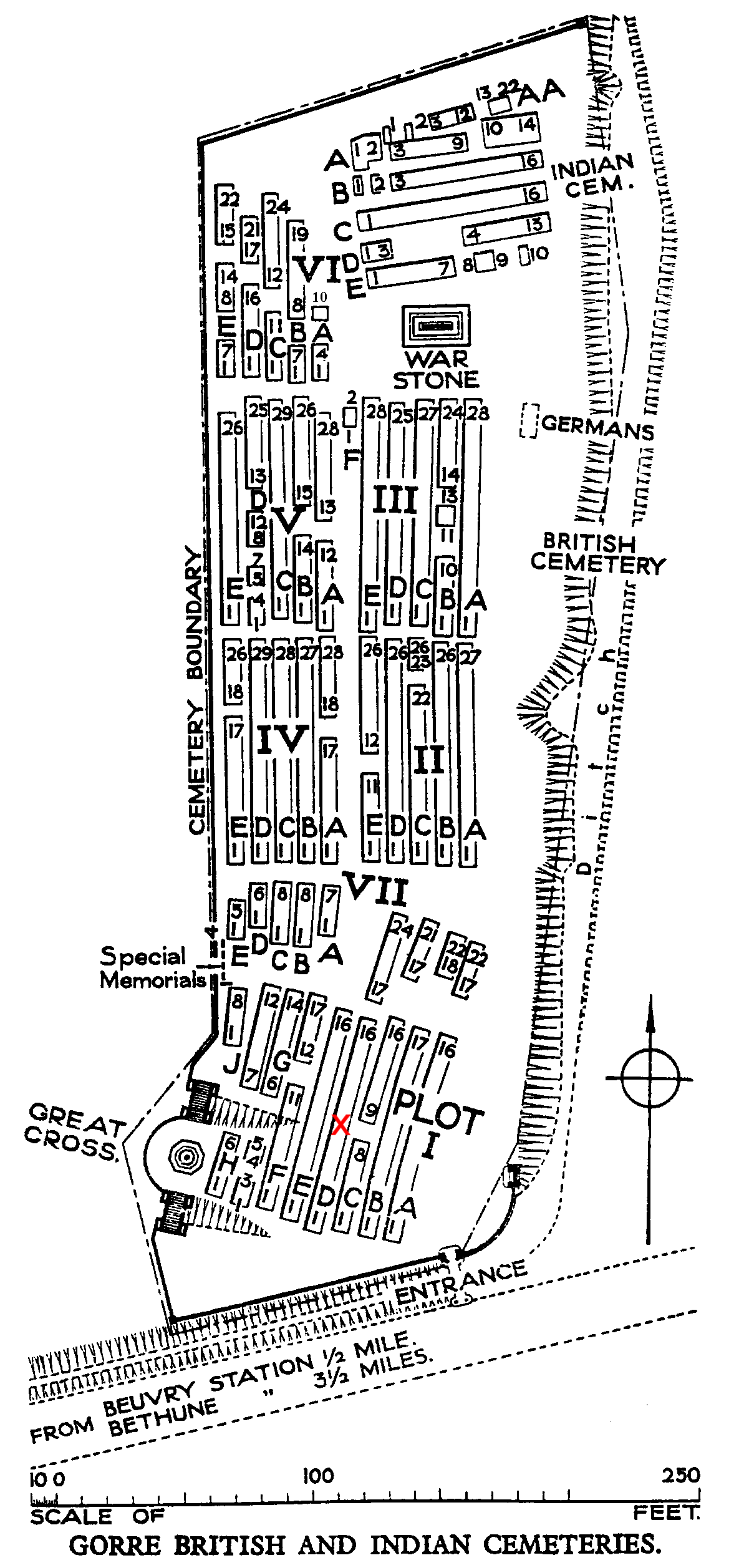
Gorre British and Indian Cemetery, Gorre, Nord-Pas-de-Calais, France: I. D. 8

      

Biography:
Robert John Rands was born, in Knightsbridge, in about 1880. He was the son of John, ship’s steward, and Jessie. Robert’s father died in 1892 and his mother remarried, in 1894, to William Harrington Montalet Wilson. They moved to live in Brookwood in about 1907.

Robert joined the Army, probably in 1898 when he was 18. In 1901 he was an acting bombardier with “N” Battery, Royal Horse Artillery in Stanhope and Wellington Lines, Aldershot.

In July 1909, Robert married Anne Eliza Carter. They had a son and a daughter.

By the time of the 1911 census, Robert was a sergeant; he was in Egypt with “T” Battery. His trade is given as ‘porter’ which is presumably what he was doing before he joined up.

In July 1914, the Army & Navy Gazette reports that “T” Battery was in Abbassia near Cairo. “T” Battery finally arrived at Merville on 21 December 1914, joining XIV Brigade and the British Expeditionary Force.

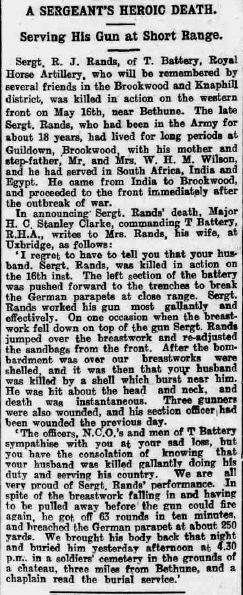
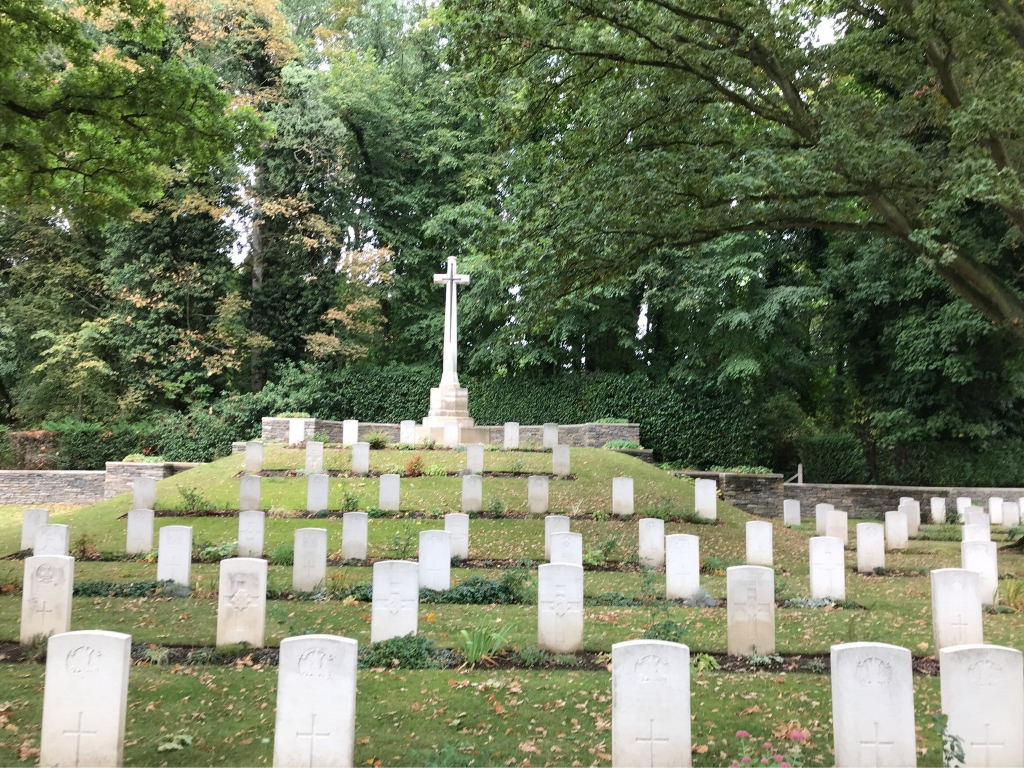
Robert John Rands was killed on 16 May 1915. He is buried, in grave I. D. 8, within Gorre British and Indian Cemetery, Gorre, France.


The chateau at Gorre was occupied early in the war by troops serving with the British Expeditionary Force and the Indian Corps. From the end of the Battle of Festubert in May 1915 until the spring of 1918, this was considered a relatively ‘quiet’ sector.

The cemeteries, located in the south-east corner of the original chateau grounds, were begun in the autumn of 1914. The Indian section of the cemetery was closed in October 1915, shortly before the Indian infantry divisions left France for redeployment to the Middle East. There are now over 930 Commonwealth servicemen of the First World War buried or commemorated here. The cemetery, which was designed by Charles Holden, also contains nine war graves of other nationalities, most of them German.