William David Ingram

Home page

Appears as:

Born:

Parents:

Unit:

No.:

Rank:

Died:

Grave/Memorial: 
Ingram, William D

1884, Aldershot, Hampshire ?

George and Alice (née ) ?

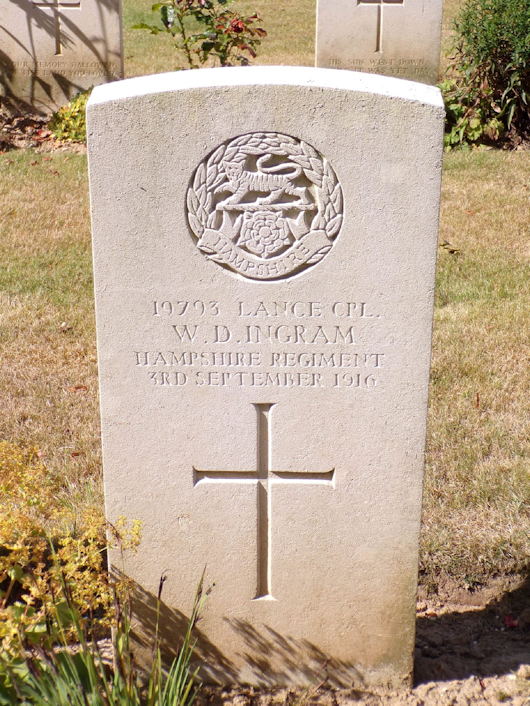
1st, 10th & 14th Battalions, Hampshire Regiment

19793

Lance Corporal

3 September 1916, 100th Field Ambulance, France, age 32

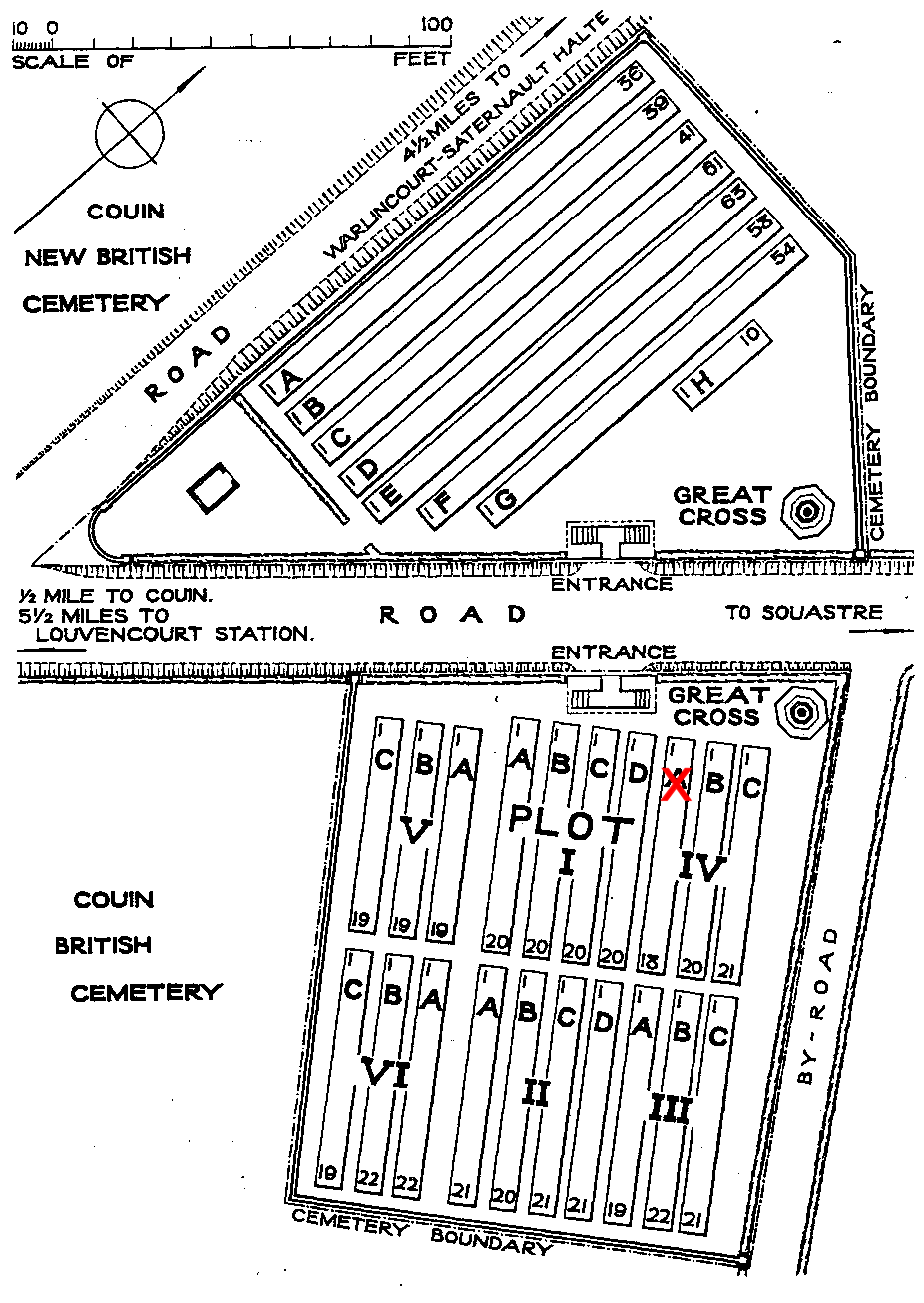
Couin British Cemetery, Couin, Nord-Pas-de-Calais, France: IV. A. 3

   

Biography:
William David Ingram‘s early life is something of an enigma and it is possible that this was not his original name.

On 20 June 1910, William married Annie Harmes. He gave his age as 26 (inferring he was born in 1883/4) and his father as
George Ingram, a waiter, deceased [
No corresponding birth has been found. No marriage between a George Ingram and an Alice has been found, nor
a marriage between Alice Ingram and Thomas Devonport]. He was living in Aldershot and working as a labourer. In the 1911 census,
William was working as a domestic groom in Windsor; he and Annie claimed to have been married for five years – presumably to
give some legitimacy to Annie’s two-year old daughter.

In February 1907, William had enlisted with the East Yorkshire Regiment, giving his occupation as ‘groom’ and his age as 19 years
and 10 months – suggesting he was born in April 1888. He stood 5 feet 6¼ inches tall, had a fresh complexion, brown hair and brown eyes.

To the question ‘Have you ever served in the Army, the Marines …’ William answered “No. Except in the militia in which I am
still serving”. On 28 May he was transferred to 1st Battalion, East Yorkshire Regiment.

For ‘next of kin’, William stated his mother, Alice, and step-father Thomas Devonport, living in Aldershot.

On 20 August 1907, William was sent for trial (it is unclear what for). He was tried on the 23rd and sentenced to 14 days detention
(7 days remitted) – he returned to duty on 30th.

On 8 November 1907, William was given 14 days detention by his Commanding Officer, returning to duty on the 22nd.

On 8 January 1908, William was transferred to the 2nd Battalion and immediately deployed to India. He returned home on 4
November 1909.

Whilst in India, on 20 July 1909, William was tried by a District Court Martial for ‘After having been discharged with disgrace
from a part of His Majesty’s Forces, enlisting in the regular forces without declaring the circumstances of his discharge’. He was
sentenced to 112 days detention. On 4 November 1909, William was attached to 3rd Battalion and discharged for misconduct.
A court martial is a military court or a trial conducted in such a court. A court martial is empowered to determine the guilt of members of the armed forces
subject to military law, and, if the defendant is found guilty, to decide upon punishment. A District Court Martial tried more serious crimes than a Regimental
Court Martial.

In February 1913, William and Annie had a daughter together; they were then living back in Aldershot. By 1915, they had moved
to St John’s and were living in Temple Bar.

After the outbreak of the war, William volunteered for service. We know he was with the Hampshire Regiment; UK Soldiers Died
in the Great War, 1914-1919
states in a comment that he was previously with the Berkshire Regiment. His entry in the Medal and
Award Rolls for the 1914-15 star tells us that he disembarked in the Balkans Theatre (probably Salonika) on 3 October 1915. The
Medal and Award Rolls for the British War Medal and Victory Medal state that he served with the 10th Battalion and 1st Battalion
before transferring to the 14th Battalion.

William David Ingram was with the 14th Battalion at the Battle of the Somme in September 1916. He died of wounds at 100th
Field Hospital on 3 September 1916 – the battalion suffered around 440 casualties that day. William is buried, in grave IV. A. 3,
within the Couin British Cemetery, Couin, France.


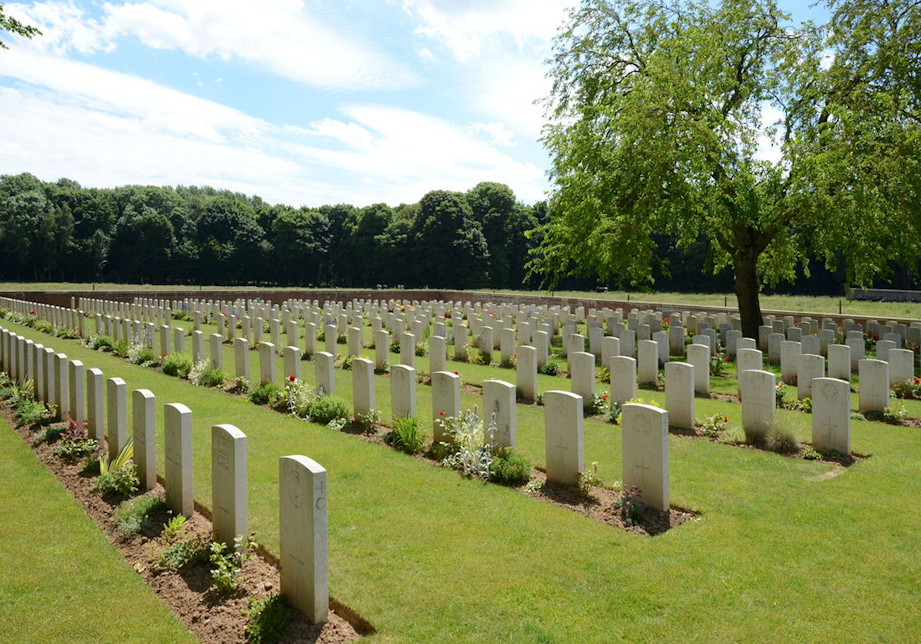
Couin Chateau was used as a divisional headquarters from 1915 to 1918. The British
Cemetery, designed by Sir Reginald Blomfield, was begun in May 1916 by the field
ambulances of the 48th (South Midland) Division, and was used by units and field ambulances
during the Battle of the Somme in 1916. It was closed at the end of January 1917 because
further extension was not possible, and now contains 401 Commonwealth burials of the First
World War and three German graves.