William Benjamin Heath

Home page

Appears as:

Born:

Parents:

Unit:


No.:

Rank:

Died:

Grave/Memorial: 
Heath, William B

23 December 1883, Liss, Hampshire

Ebenezer & Mary (née Purchase)

22nd Infantry Labour Company, The Queen's (Royal West Surrey)
Regiment / 130th Labour Company, Labour Corps

52833 / 77438

Private

10 March 1918, France, age 34

Philosophe British Cemetery, Mazingarbe, Nord-Pas-de-Calais,
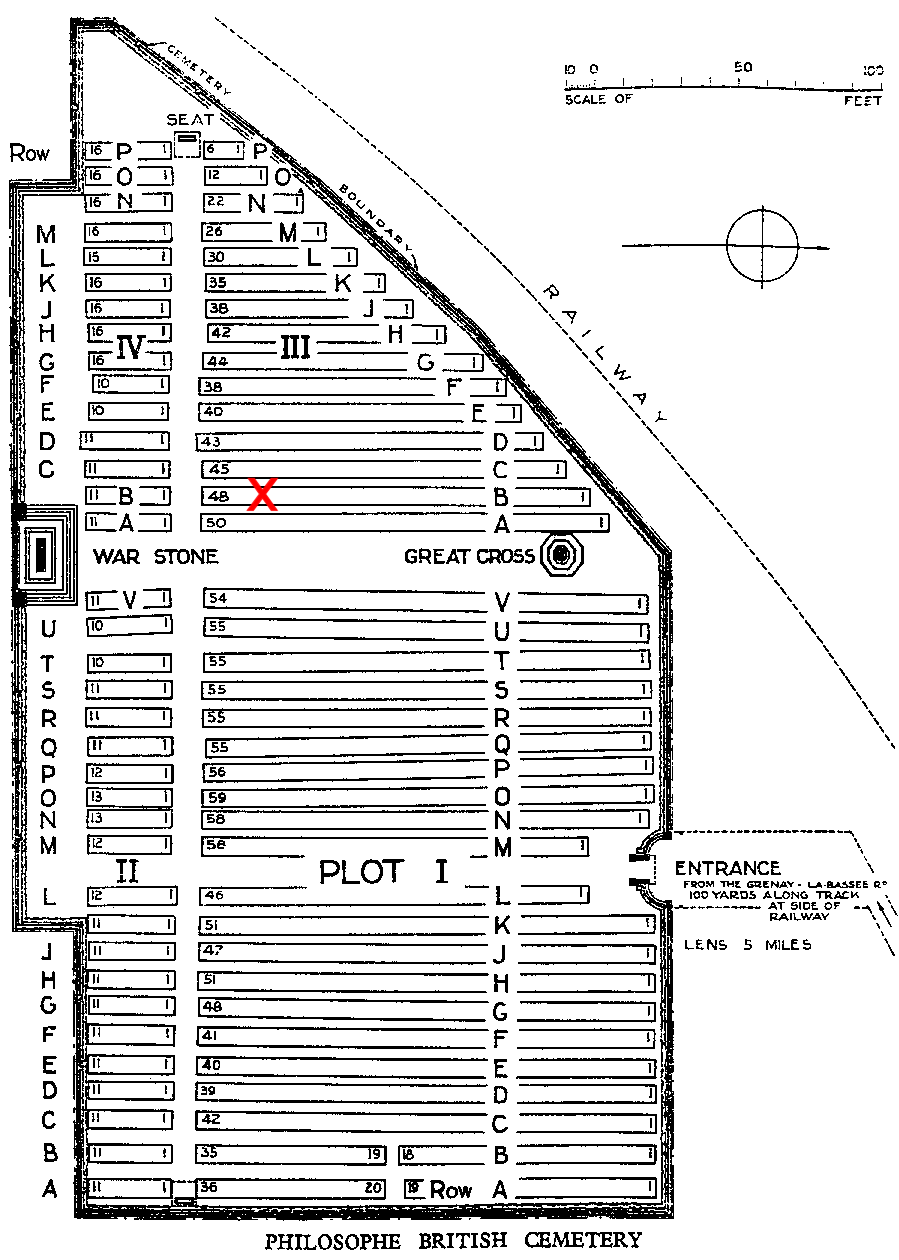
France: III. B. 42

   

Biography:
William Benjamin Heath was born on 23 December 1883, in Liss, Hampshire. He was the son of Ebenezer & Mary Jane (née
Purchase). He had one brother. William’s father died when he was 9 years old and his mother remarried. They had another son.
William’s mother died in 1908, when he was 25.

After leaving school, William worked as a grocer’s assistant in Guildford. He married Lilian Jane Ketteringham, in Liss, in 1907.
Together, they had two sons. By 1915, when their second son was born, William and Lilian had moved to Knaphill, where
Benjamin was manager of the Co-Op.

William joined up in December 1915, attesting with The Queen's (Royal West Surrey) Regiment, and was put into the Army
Reserve. He stood 5 feet 2½ inches tall; his complexion was described as ‘fresh’, he had blue eyes and brown hair.

William was mobilized on 1st March 1917 and assigned to 22nd Infantry Labour Company. On 5 May 1917, he was transferred to
103rd Labour Company.

The 22nd Infantry Labour Company was part of the Labour Corps formed by the British Army, primarily for manual labour on the Western Front and
Salonika. This Labour Corps was made up of men not fit for front-line duty.

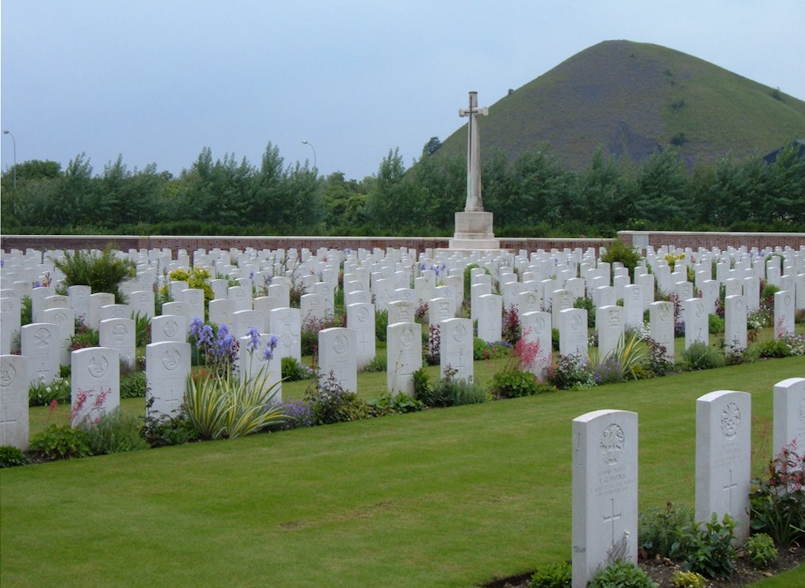
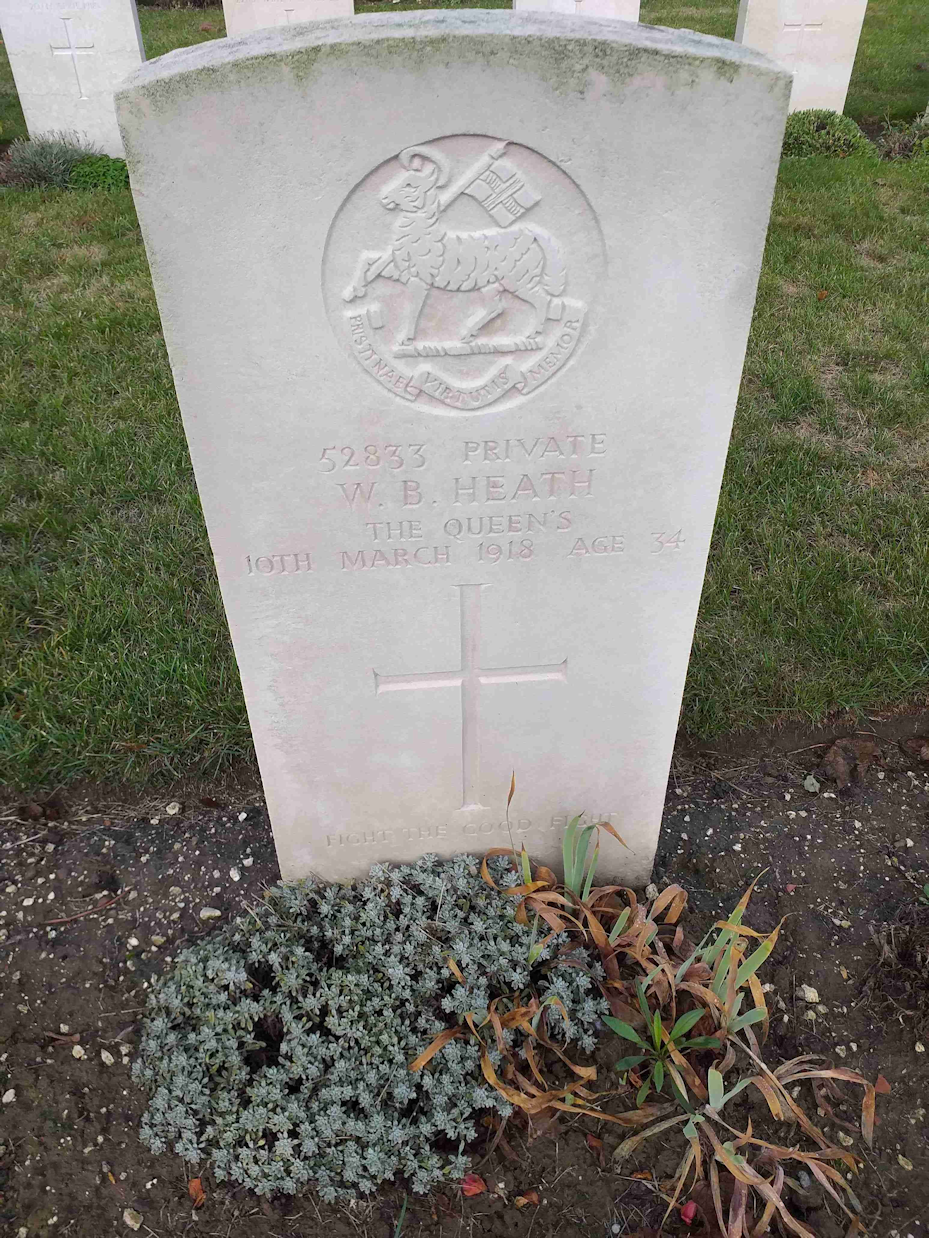
William Benjamin Heath was killed by shell fire on 10 March 1918. He is buried, in grave III. B. 42, within the Philosophe British Cemetery, Mazingarbe, Nord-Pas-de-Calais, France.


The Philosophe British Cemetery, designed by Sir Herbert Baker, was started in August 1915. In 1916 it was taken over by the 16th (Irish) Division, who
held the Loos Salient at the time, and many of their dead were brought back to the cemetery from the front line. Succeeding divisions used the cemetery until
October 1918, and men of the same Division, and often the same battalion, were buried side by side.

After the Armistice, this cemetery was one of those used for the concentration of isolated graves from the Loos battlefield. The bodies of 41 men of the 9th
Black Watch were brought from positions a little West of Loos, and those of 340 officers and men of other Regiments from different points in the communes
of Cambrin, Auchy, Vermelles, Halluch and Loos.

There are now 1,996 Commonwealth burials of the First World War in the cemetery, 277 of them unidentified.


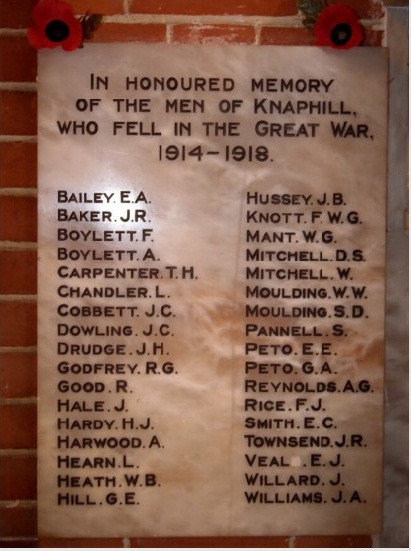
William Benjamin Heath is also commemorated on the
memorial tablet within Knaphill Holy Trinity Church.