Herbert Harding

Home page

Appears as:

Born:

Parents:

Unit:

No.:

Rank:

Died:

Grave/Memorial: 
Harding, Herbert

1892 Mayford, Woking, Surrey

Kate (née Harding) [BB]

3rd Battalion, Duke of Cambridge's Own (Middlesex) Regiment

11204

Private

27-30 September 1915, age 23

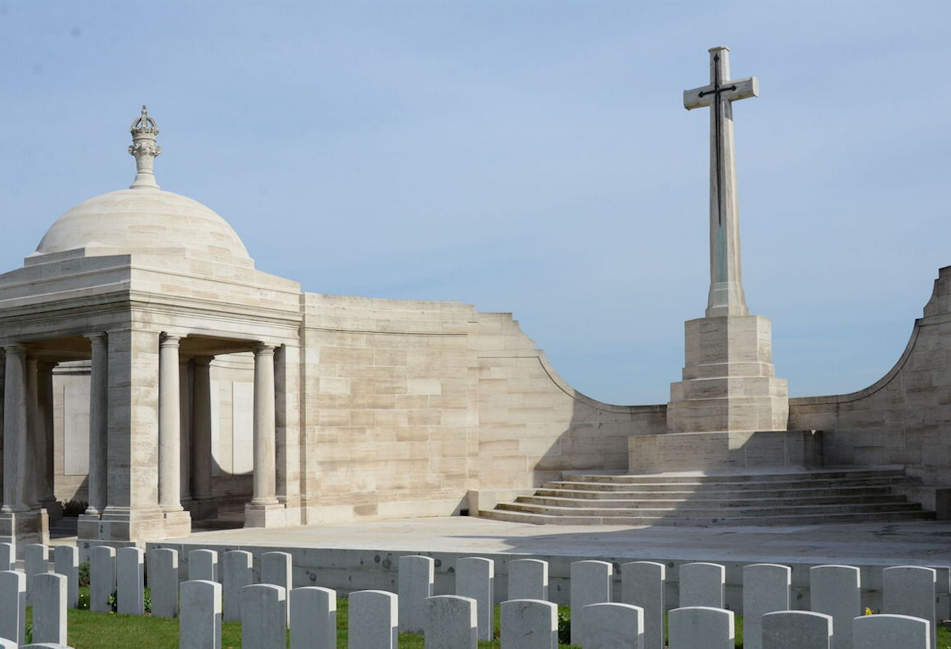
Loos Memorial at Dud Corner Cemetery, Loos-en-Gohelle, France:
Panels 99 to 101
   

Biography:
Herbert Harding was born in April 1892, in Mayford, Woking, Surrey. He was the illegitimate son of Kate Elizabeth Harding. Kate
also had a daughter, also named Kate, in 1894. In 1899 she married John Earl, with whom she had a further seven children.

Herbert joined the Army in June 1906, when he was just 14. He enlisted at Guildford and became a bandsman with the Duke of
Cambridge's Own (Middlesex) Regiment. He stood 4 feet 10 inches tall and weighed 75 pounds; he had dark brown hair and
green-hazel eyes.

From June 1906 until end October 1907, Herbert was deployed to Londonderry, with the 3rd Battalion. From there he moved to
Hong Kong, arriving in December 1907. A year in Hong Kong was followed by two years in Singapore. After two years in the UK,
Herbert arrived in Cawnpore, India in November 1912.

The 3rd Battalion returned to England in December 1914, moved to Winchester and were attached to 85th Brigade in 28th
Division. The battalion landed at Le Havre on 19 January 1915.

In the Battle of Loos, on the morning of the 28th September, 3rd Battalion was supporting the Buffs in an attack on the
Hohenzollen Redoubt; the battle continued until the 30th. Herbert Harding was killed between 27th and 30th September 1915.
His final resting place is unknown; his name appears, with others of his regiment, on Panels 99 to 101 of the Loos Memorial.


Dud Corner Cemetery stands almost on the site of a German strong point, the Lens Road Redoubt, captured by the 15th (Scottish) Division on the first day
of the battle.

The Loos Memorial, designed by Sir Herbert Baker with sculpture by Charles Wheeler, commemorates over 20,000 officers and men who have no known
grave, who fell in the area from the River Lys to the old southern boundary of the First Army, east and west of Grenay, from the first day of the Battle
of Loos to the end of the war.

On either side of the cemetery is a wall 15 feet high, to which are fixed tablets on which are carved the names of those commemorated. At the back are four
small circular courts, open to the sky, in which the lines of tablets are continued, and between these courts are three semicircular walls or apses, two of which
carry tablets, while on the centre apse is erected the Cross of Sacrifice.