Tyne Cot Cemetery is located in an area which was known as the Ypres Salient where Commonwealth,
French, Belgian and German forces fought almost continuously throughout the First World War.
In 1917, British forces launched the Third Battle of Ypres; on 4 October, during the phase known as the
Battle of Passchendaele, the 3rd Australian Division captured a group of German bunkers.
One of these bunkers was unusually large and was used as an advanced dressing station after its capture.
From 6 October 1917 to the end of March 1918, 343 graves were made, on two sides of it, by the 50th
(Northumbrian) and 33rd Divisions, and by two Canadian units.
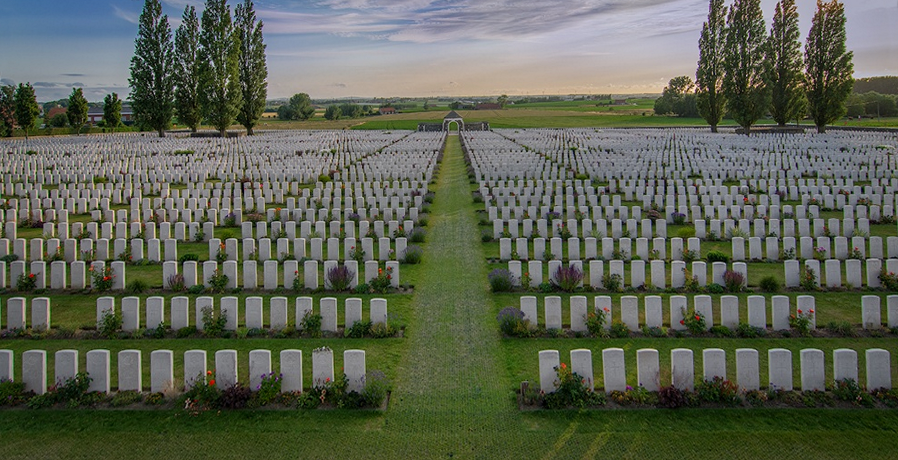
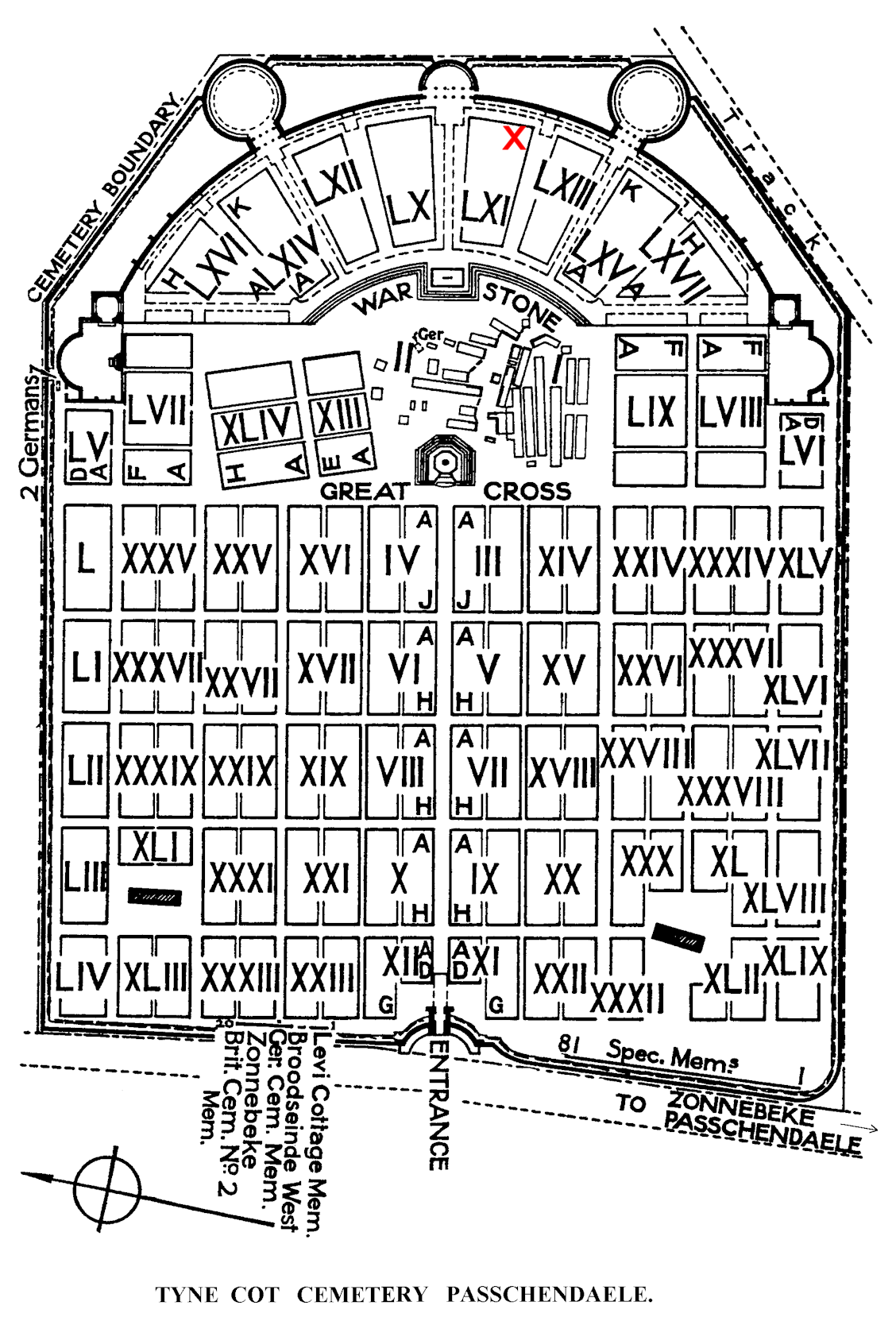
Tyne Cot Cemetery, designed by Sir Herbert Baker, was greatly enlarged after the Armistice when
remains were brought in from the battlefields of Passchendaele and Langemarck, and from a few small
burial grounds. It is now the largest Commonwealth war cemetery in the world in terms of burials. At the
suggestion of King George V, who visited the cemetery in 1922, the Cross of Sacrifice was placed on the
original large pill-box.
There are now 11,961 Commonwealth servicemen of the First World War buried or commemorated
in Tyne Cot Cemetery. 8,373 of the burials are unidentified.
|
 |