John Henry Drudge

Home page

Appears as:

Born:

Parents:

Unit:

No.:

Rank:

Died:

Grave/Memorial: 
Drudge, John H

10 August 1893, Ash, Surrey

George and Annie (née Stevens)

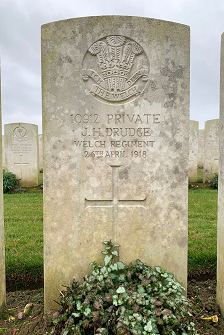
2nd and 13th Battalions, Welch Regiment

10912

Private

26 April 1918, age 24

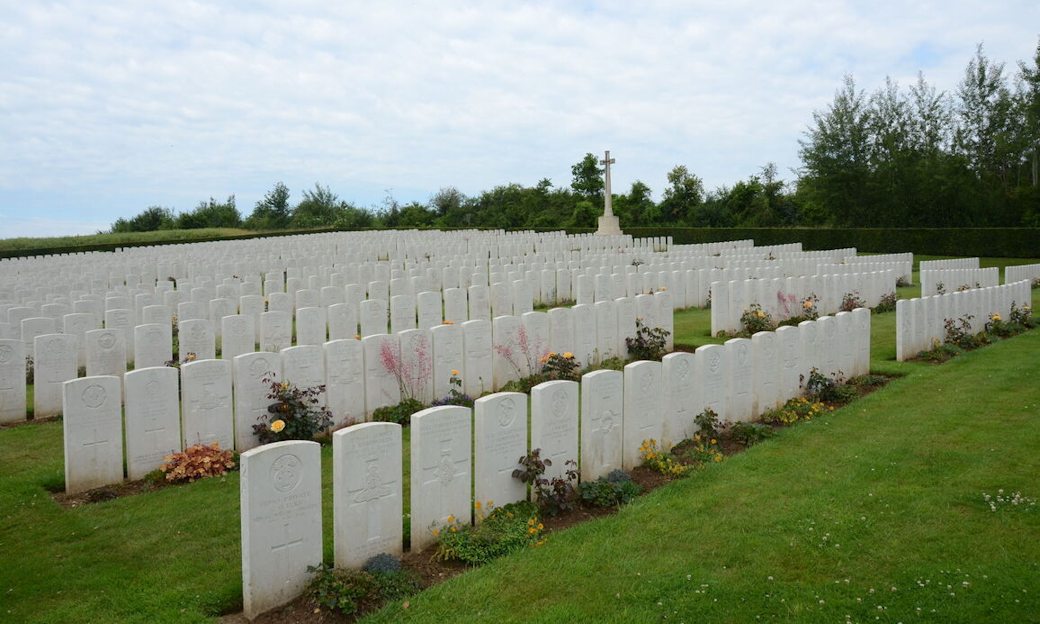
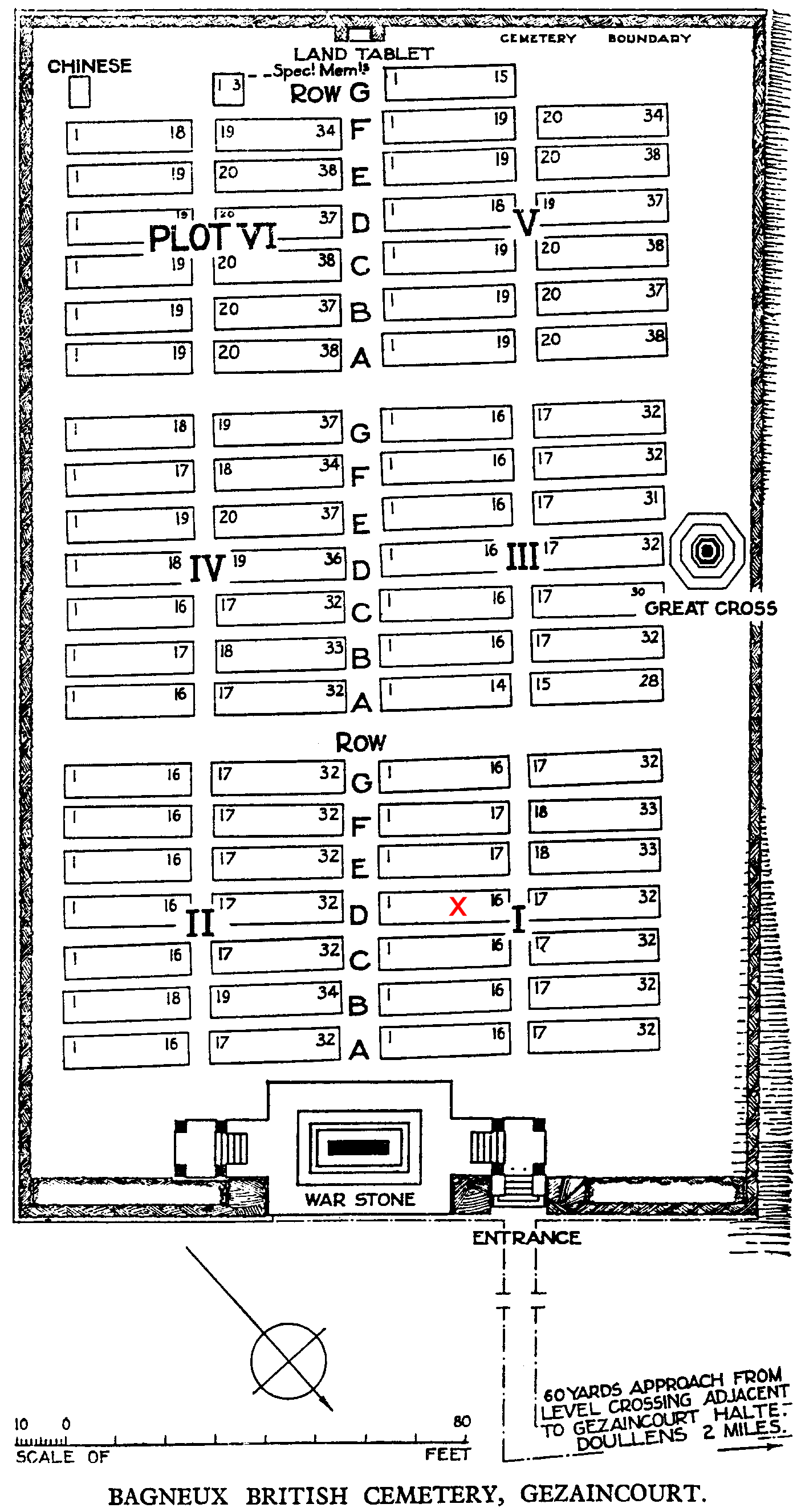
Bagneux British Cemetery, Gézaincourt, Departement
de la Somme, Picardie, France: I. D. 9

   

Biography:
John Henry Drudge was born on 10 August 1893, in Ash, Surrey. He was the son and seventh of thirteen surviving children of George, a domestic gardener, and Annie Ruth (née Stevens).

After leaving school, John worked as a domestic gardener.

John joined the Welch Regiment in late 1914. He was deployed to France on 27th January 1915, with the 2nd Battalion. After a
period at the Infantry Base Depot, he was transferred to the 13th Battalion.
The Infantry Base Depot was a holding camp; situated within easy distance of one the Channel ports, it received men on arrival from England and kept
them in training while they awaited posting to a unit at the front.

In 1916, John married Lilian Eleanor Theobald. They had had a daughter together, born in September 1915.

The Battle of the Lys, also known as the Fourth Battle of Ypres, was fought from 7 to 29 April 1918 and was part of the German
spring offensive in Flanders. It had the objective of capturing Ypres, forcing the British forces back to the Channel ports and out of
the war. This included the Second Battle of Kemmel; from 25–26 April, the German Fourth Army made a sudden attack on the
Kemmelberg with three divisions and captured it.

John Henry Drudge was injured and died of wounds on 26 April 1918. He is buried in grave I. D. 9, within Bagneux British
Cemetery, Gézaincourt, France.


At the end of March, the 3rd, 29th and 56th Casualty Clearing Stations moved to Gezaincourt,
where they were joined for a short time in April by the 45th. They remained until September.

The cemetery, designed by Sir Edwin Lutyens, was begun in April 1918, after the close of the
German offensive in Picardy. There are 1,374 servicemen of the First World War buried or
commemorated in the cemetery.

    
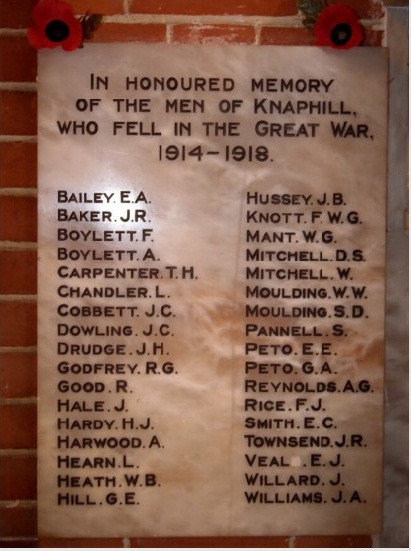
John Drudge is also commemorated on the memorial tablet within Knaphill
Holy Trinity Church.