John Ernest Denyer

Home page

 
Appears as:

Born:

Parents:

Unit:

No.:

Rank:

Died:

Grave/Memorial: 
Denyer, John E

3 September 1898, Woking, Surrey

John and Sarah (née Newman)

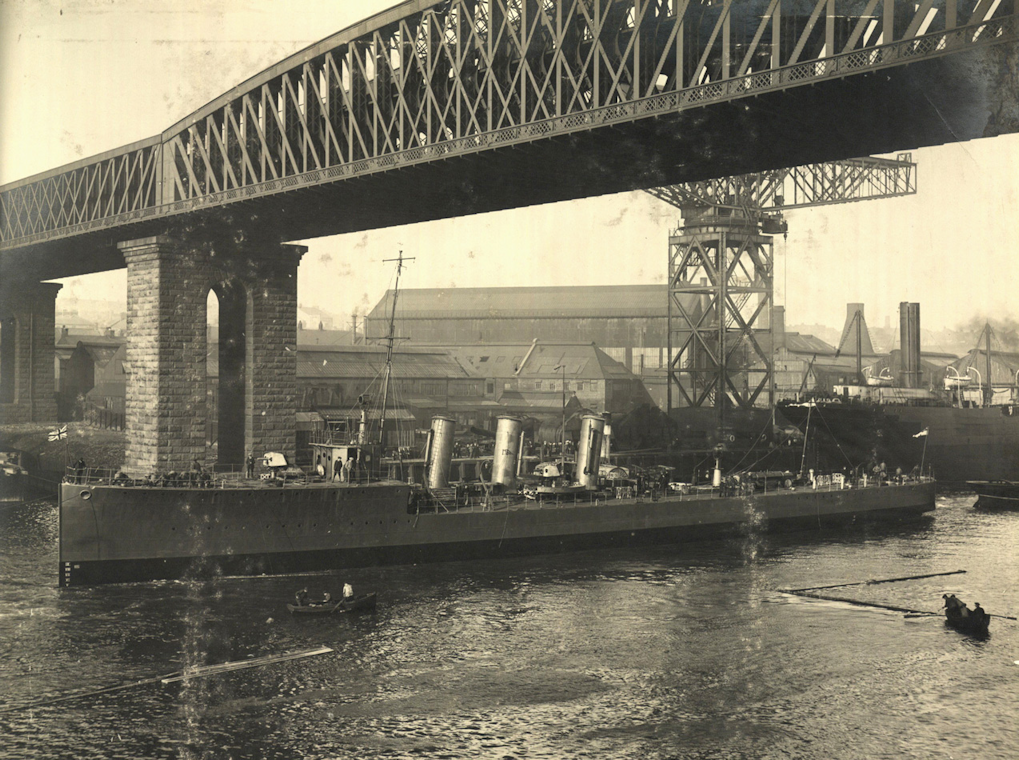
Royal Navy (H.M.S. Opal)

L.8366

Officers’ Cook 3rd Class

12 January 1918, at sea

Body not recovered for burial.
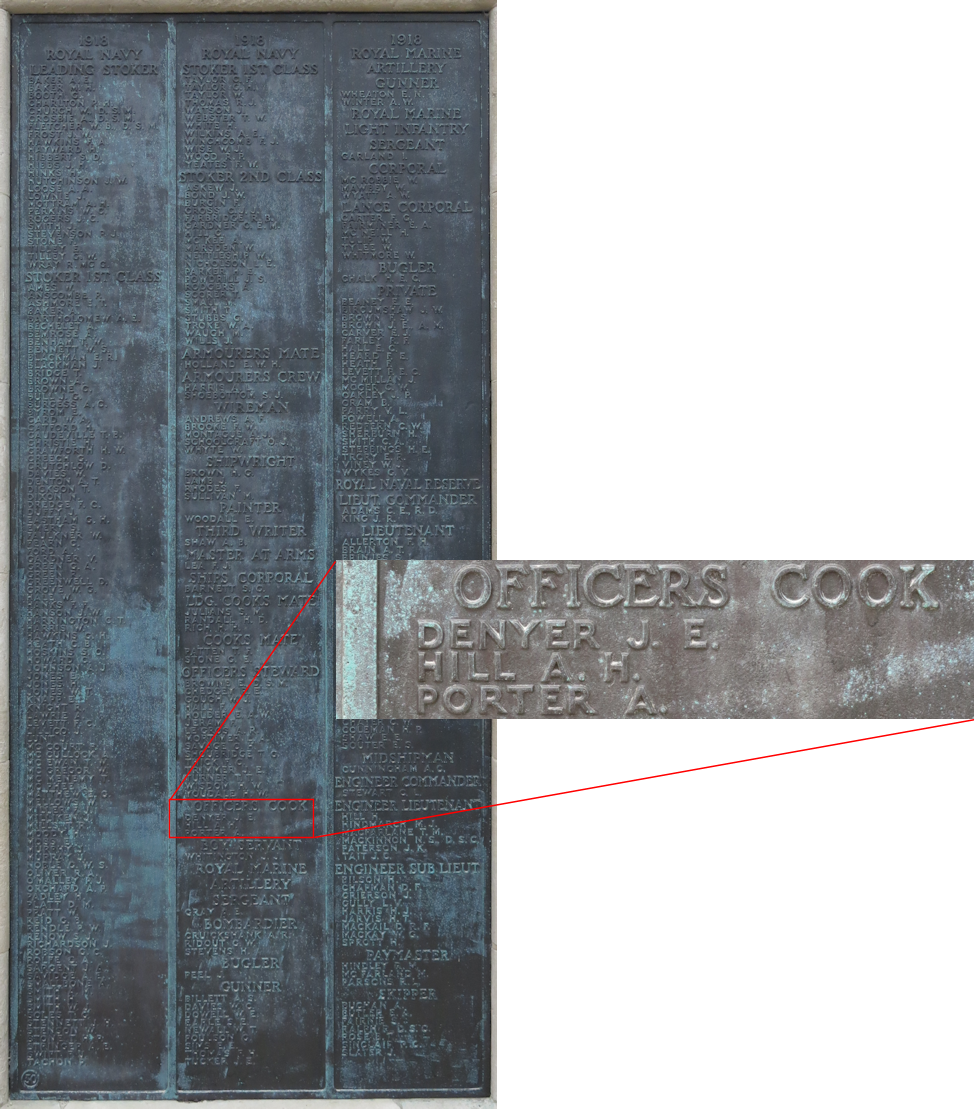
Portsmouth Naval Memorial, England

   
Biography:
John Ernest Denyer was born, on 3 September 1898, at Woking, Surrey. He was the son and third child of John, a navvy and, later, fishmonger, and Sarah (née Newman).

On leaving school, John was employed as a gardener. He joined the Royal Navy on 19 February 1916 aged 17, as a ‘Boy
servant’. He stood 5 feet 7 inches tall; his complexion was described as ‘sallow’; he had grey eyes and dark brown hair.
In the 18th-century Royal Navy, rank and position on board ship was defined by a mix of two hierarchies, an official hierarchy of ranks and a
conventionally recognized social divide between gentlemen and non-gentlemen. Boys would join the navy from the age of 12 and they would serve
either as a servant for one of the officers, as a volunteer, or as a seaman.

John was promoted to Officers’ Steward 3rd class on 3 September 1916.

John Ernest Denyer was killed when H.M.S. Opal broke up and sank, on 12 January 1918 His body was never recovered.


At 9.27 pm on the 12th January 1918, H.M.S. Opal sent a garbled radio message stating it had run aground, followed by silence.

Its wrecked remains were found two days later along with those of its sister ship, H.M.S. Narborough, off the east coast of South Ronaldsay near to Hesta
Head. The double tragedy which resulted in the loss of all but one of the 189 crew, is remembered on a stone and brass memorial at Windwick near to
where the vessels ran aground.

Both ships were Royal Navy destroyers attached to the 12th Destroyer Flotilla based with the Grand Fleet in Scapa Flow during WWI. During both World
Wars, the Admiralty used Scapa Flow as its principal naval anchorage due to its strategic location.

On the 12th January 1918, H.M.S. Opal and H.M.S Narborough set out on a night patrol of the Orkney coast, along with the light cruiser, Boadicea.
They were searching for German minelayers or submarines trying to disrupt operations in Scapa Flow. Less than 2 years earlier, German mines were
responsible for sinking H.M.S. Hampshire off the coast of Orkney which resulted in the loss of 737 lives, including that of the Secretary of State for War,
Lord Kitchener.

Both ships were ordered to return to base when the weather began to significantly deteriorate. As they set sail back to Scapa Flow, a snowstorm had
reduced visibility to near zero and heavy seas further added to the extreme conditions. When the radio message arrived stating the Opal had ran aground, the
severe weather meant rescue vessels were unable to head out until the following morning.

It was two days before H.M.S. Opal was located, broken up on the rocks near Hesta. H.M.S Narborough was found in a similar position nearby. Out of the
189 crew, 188 had died during the incident although only 55 bodies were recovered.

One survivor — William Sissons — was later located on a small islet, and he related that the ships had been sailing a regular slow course making frequent
soundings and radio reports, but had suddenly crashed headlong into the rocks, probably due to a navigation error by Opal's captain.

John Ernest Denyer is commemorated on Panel 30 on the Portsmouth Naval Memorial, Portsmouth, Hampshire, England.