James Charles Cobbett

Home page

Appears as:

Born:

Parents:

Unit:


No.:

Rank:

Died:

Grave/Memorial: 
Cobbett, James C

2 September 1898, Horsell, Surrey

James and Minnie (née Robinson)

12th Battalion, Suffolk Regiment /
20th Battalion, Durham Light Infantry

45493 / 44798

Private

4 September 1918, Belgium, age 20

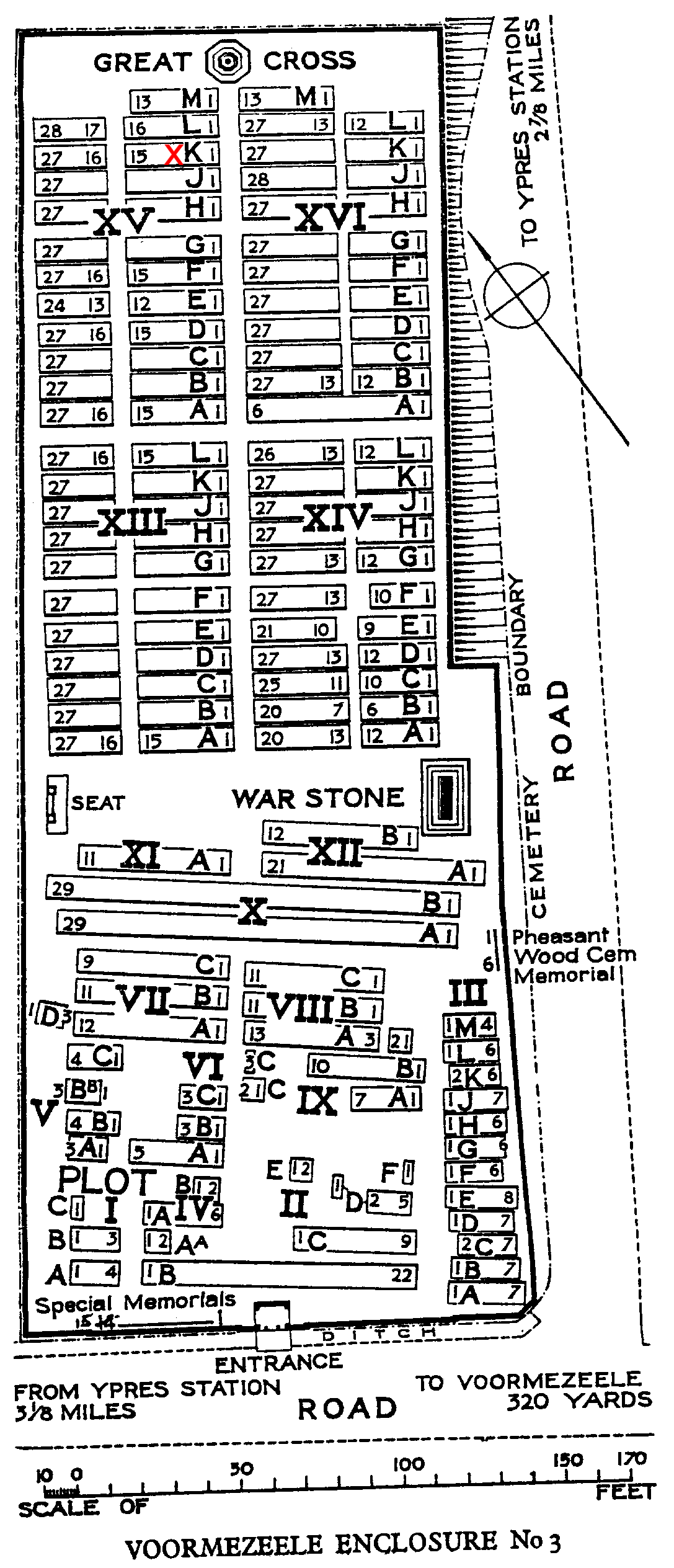
Voormezeele Enclosure No. 3, Ypres, Belgium: XV. K. 7
 
Biography:
James Charles Cobbett was born, in Horsell, on 2 September 1898. He was the eldest son of James, an attendant at Brookwood Hospital, and Minnie Prentice (née Robinson). James had a brother and a sister.

James enlisted with the 12th Battalion, The Suffolk Regiment 5 days before his 18th birthday, on 28 August 1916. 12th (Service)
Battalion, Suffolk Regiment (East Anglian) was a ‘Bantam’ battalion (James is recorded as 5 feet 6½ inches tall with a chest
measurement of 33½ inches). He had a fresh complexion, blue eyes and brown hair.


At the outbreak of World War One, the height requirement for recruits to the British Army was 5ft 3 inches (160cm), with a chest measurement of at least
34 inches (86.36cm). It soon became apparent that this rule excluded many men, especially those from industrial and coal mining areas, who were otherwise
perfectly fit to serve.
Alfred Bigland, MP for Birkenhead, wrote to the Secretary of State for War, Lord Kitchener. Bigland criticised what he saw as the needless rejection
of fit, healthy men and asked Kitchener for permission to form an undersized fighting unit. Bigland decided to raise his own company, composed of
men between 4 ft 10ins (140cm) and 5ft 3ins (160cm) tall. They were named Bantams after the small aggressive fowl which became their battalion
emblem. The idea quickly spread to other parts of the country.

James was mobilised on the 29 January 1917. On 1 May, he was transferred to the 20th Battalion, Durham Light Infantry. In
November 1917 they moved with the 41st Division to Italy but returned to France in March 1918. In September 1918, 20th
Battalion were part of the 20th (Light) Division and was actively involved in the final Allied offensives on the Western Front.

James Charles Cobbett was killed on 4 September 1918. He is buried in grave XV. K. 7 within Voormezeele Enclosure No. 3,
Ypres, Belgium.


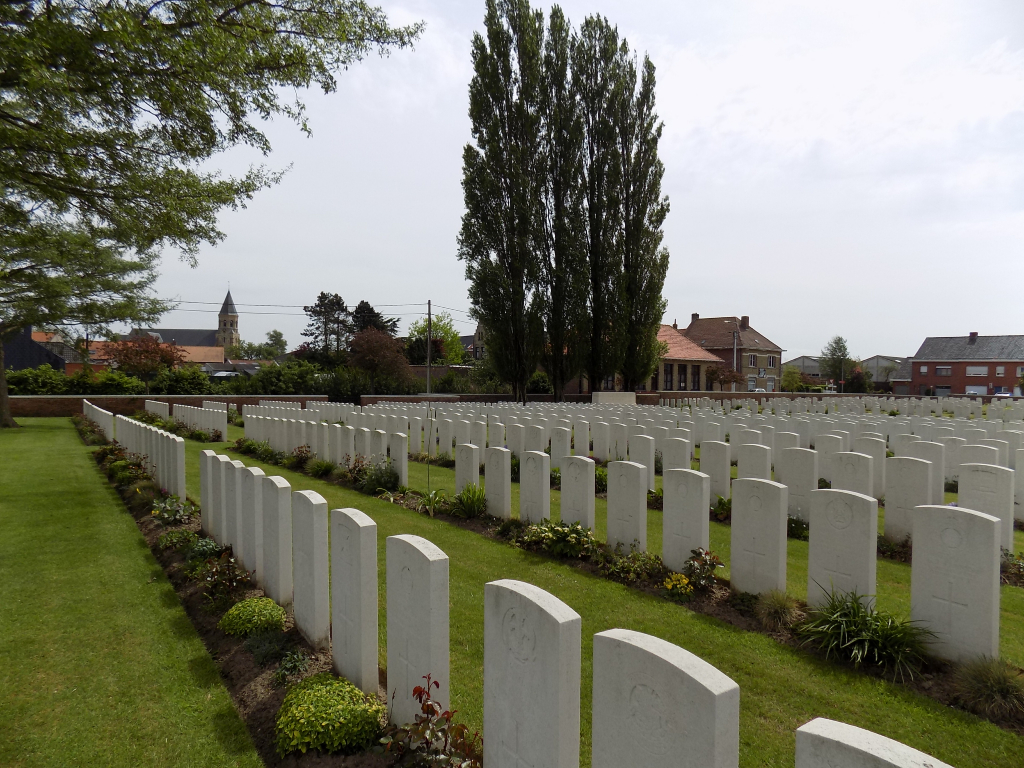
     The Voormezeele Enclosures (at one time there were a total of four, but now reduced to three)
were originally regimental groups of graves, begun very early in the First World War and
gradually increased until the village and the cemeteries were captured by the Germans in 1918.

Voormezeele Enclosure No.3, the largest of these burial grounds, was begun by the Princess
Patricia's Canadian Light Infantry in February 1915. Plots XIII to XVI were made after the
Armistice when graves were brought in from isolated sites and smaller cemeteries to replace
the French graves (of April and September 1918) that were removed to a French cemetery.
These concentrated graves cover the months from January 1915 to October 1918, and they
include those of many men of the 15th Hampshires and other units who recaptured this ground
early in September 1918.

There are now 1,611 Commonwealth servicemen of the First World War buried or
commemorated in Voormezeele Enclosure No.3. The cemetery was designed by Sir Edwin
Lutyens.