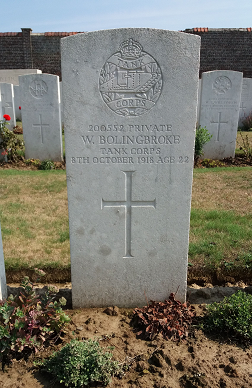
Wilfred Bolingbroke

Home page

Appears as:


Born:


Parents:


Unit:


No.:


Rank:


Died:


Grave/Memorial: 


Bolingbroke, Wilfred

23 April 1896 West Norwood

Alfred & Sarah (née Gessey)

3rd Battalion, Tank Corps

200552

Private

8 October 1918, age 22

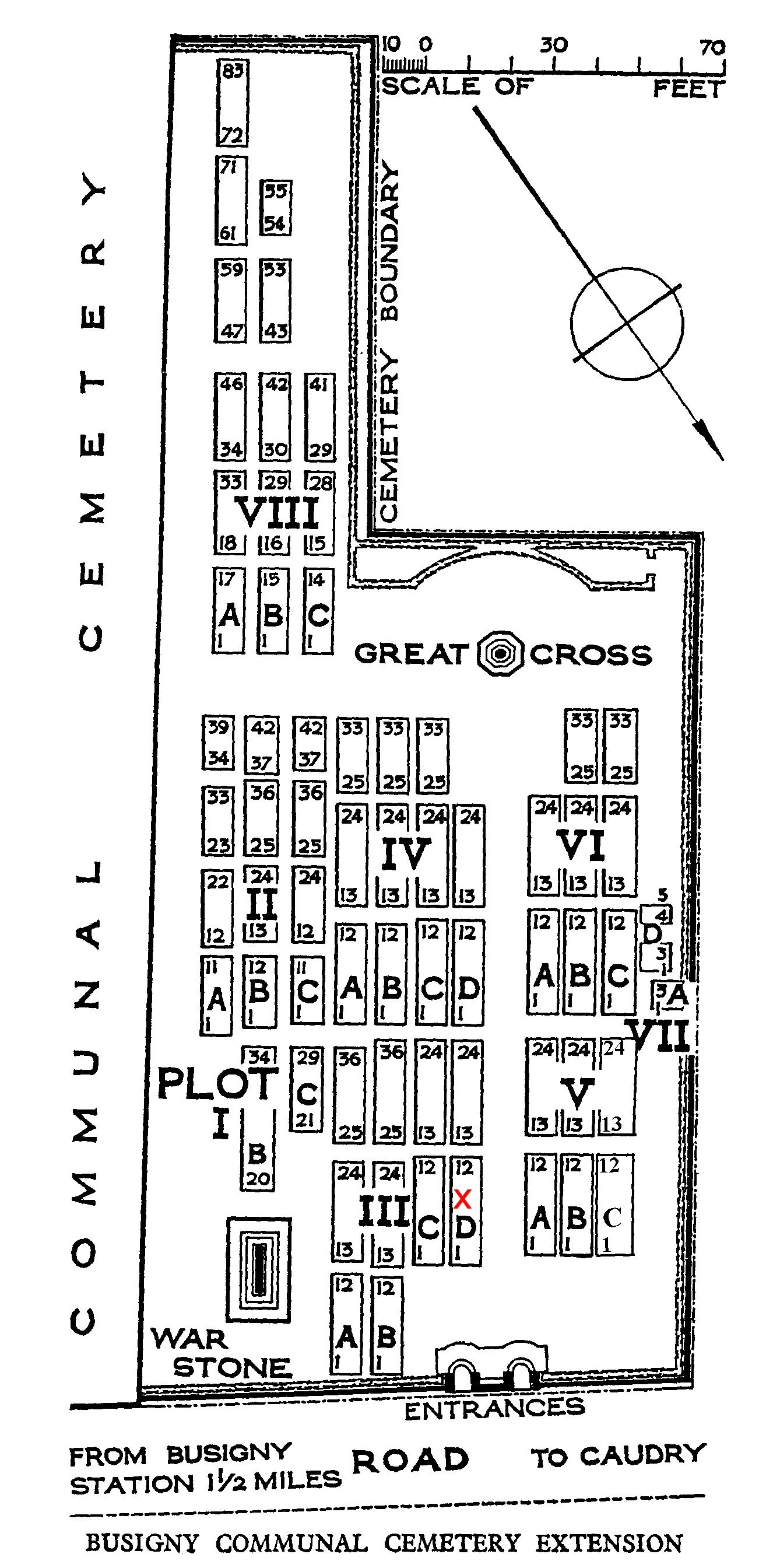
Busigny Communal Cemetery Extension, Busigny,
Nord-Pas-de-Calais, France: III. D. 7
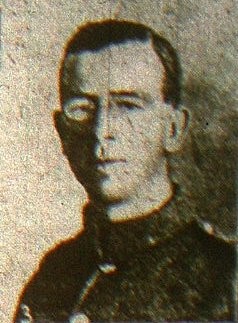
     
Biography:
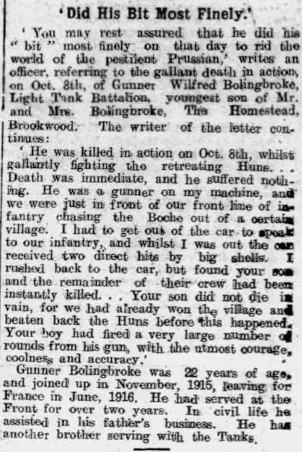
Wilfred Bolingbroke was born in West Norwood in 1896.  He was the youngest of three sons of Alfred, a monumental engraver, &
 Sarah Ann (née Gessey).  Wilfred also had four sisters.

Alfred and his family moved to Brookwood, Surrey in about 1904, where he worked for the London Necropolis Company.

In the 1911 census, Wilfred was aged 14.  He has no occupation recorded so had probably just left school or was about to.  He
reportedly went into ‘his father’s business’.

Wilfred joined up in November 1915.

Many of the original tank crewmen were recruited from the Motor Machine Gun Service, as soldiers in this force were both trained
on machine guns and experienced motorists.  Tanks were first used on the 15th September 1916 at Flers-Courcelette; by this time
the crews had transferred to the Heavy Section Machine Gun Corps.  The Tank Corps was formed on 28 July 1917.

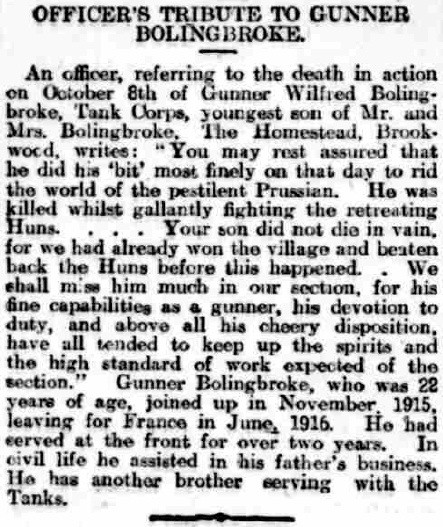
Wilfred Bolingbroke was killed on 8 October 1918, during the Battle of Cambrai.  Wilfred was in “A” Company of the 3rd Battalion,
Tank Corps.  His tank A237 “Ceylon II”, commanded by Lt Minchin, was part of a section attached to “B” Company.
From the Unit War Diary:
Orders
“B” company to pass though the infantry on the Red Line and capture Serain.
Account of Operations
The tanks set off from the overnight stop, B19 central at 05:35 and reached Bellevue farm at 6:15 where they came under fire.  The tanks halted for a short
while then moved north of La Sablonniere and then up the valley towards Hamage Farm, south of here the sections separated.
“A” section passed the red line to the south of Folie Farm at 08:10am, passing through the infantry at U19d.4.5.
A237 advanced at top speed on Serain, the fire there from ceasing on tanks approach.  The infantry had failed to advance so the tank turned back, the fire
resuming as soon as it withdrew.  The infantry advanced to the line of the Serain – Premont Road reaching same at 10:55am.  The tank then crossed the road at
U21b.1.5. and patrolled as far as u15c.8.4., being forced on for
the crests beyond the village and firing on enemy retreating up the slopes East and North East
of the village.  The tank then went back to U21b.2.4. where the OIC met with the infantry commander; whilst the OIC was outside the tank, it was hit and set
afire, the gunner and driver were trapped inside as the door was jammed.  The OIC joined the infantry and later returned to report. The tank drove 25 miles and fired 2300 SAA rounds.


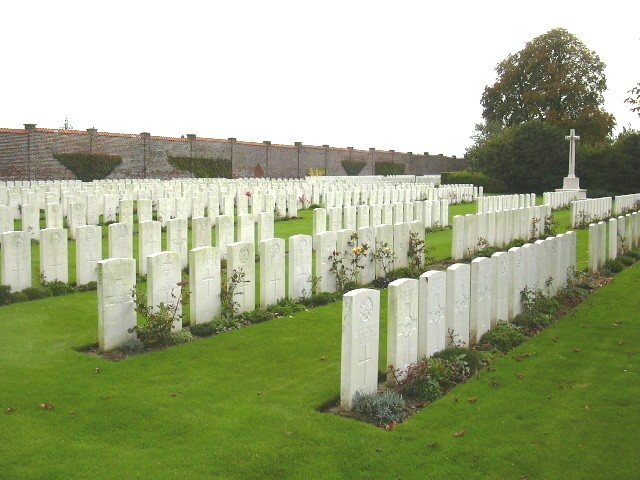
Wilfred Bolingbroke is buried in the Busigny Communal Cemetery Extension, Busigny, France.


Busigny was captured by the 30th American Division and British cavalry on 9 October 1918, in the Battle of Cambrai, and in the course of the next two months
the 48th, 37th and 12th Casualty Clearing Stations came successively to the village.  The majority of the burials were made from these three hospitals.

The Casualty Clearing Station was part of the casualty evacuation chain, further back from the front line than the Aid Posts and Field Ambulances.  It was
manned by troops of the Royal Army Medical Corps, with attached Royal Engineers and men of the Army Service Corps.  The job of the CCS was to treat a
man sufficiently for his return to duty or, in most cases, to enable him to be evacuated to a Base Hospital.

The cemetery extension, designed by Charles Holden, was begun in October 1918, and used until February 1919.  After the Armistice it was enlarged when
graves were brought into Plots II-VII of graves from a wide area between Cambrai and Guise.

It is likely that Wilfred was first buried in either Magny La Fosse Churchyard, (which contained the graves of 19 soldiers from
the UK who fell in October and November, 1918) or Maretz British Cemetery, at the South-Western end of the village of Maretz, (made
by the 1st/8th Worcesters on the 11th October, 1918, contained the graves of 16 soldiers from the UK).


Wilfred is also commemorated on the WWI memorial stone outside the Brookwood Memorial Hall.